Searching for bangs for face shape can produce a confident chart and very little help with the hair that grows above your own forehead. A fringe has to work with your parting, texture, glasses and willingness to style it. Face proportions can suggest an effect you might enjoy, such as an open centre or a strong horizontal line. Start with how your hair falls, then choose that effect deliberately. There is no obligation to make your outline appear longer, narrower or softer.
Start with growth direction and your usual texture
Look at the front of your hair when it is clean, dry and styled as you normally wear it. Notice whether it falls forward, separates in the centre, sweeps strongly to one side or lifts at a cowlick. A fringe that lies smoothly in a reference photo may need regular drying to behave that way on you. Tell your stylist how much of that work you would realistically do before choosing the length.
Texture changes the finished shape. A straight fringe can form a crisp edge; wavy pieces may separate and bend; curls make their own pattern of coverage and gaps. Ask to discuss the intended dry length and how the front behaves after washing. Do not copy a wet cutting point from a video or assume every curl will spring back by the same amount.
Bring the everyday constraints into this first conversation. Do you wear glasses, sweat under a helmet, tuck hair behind your ears or dislike strands touching your eyelashes? Those details can rule out an inconvenient length before the face-shape discussion begins. A longer starting point may be useful when you are uncertain, provided the stylist checks that it will sit comfortably.
Choose where the fringe should end in its dry state
The endpoint changes what you notice around the eyes and cheeks. A short fringe leaves more of the forehead visible. A brow-skimming line creates a stronger horizontal division. Longer curtain pieces open at the centre and fall along the sides. These are different visual choices, rather than steps on a scale from wrong to right. Try to name the feature of a photo you actually like.
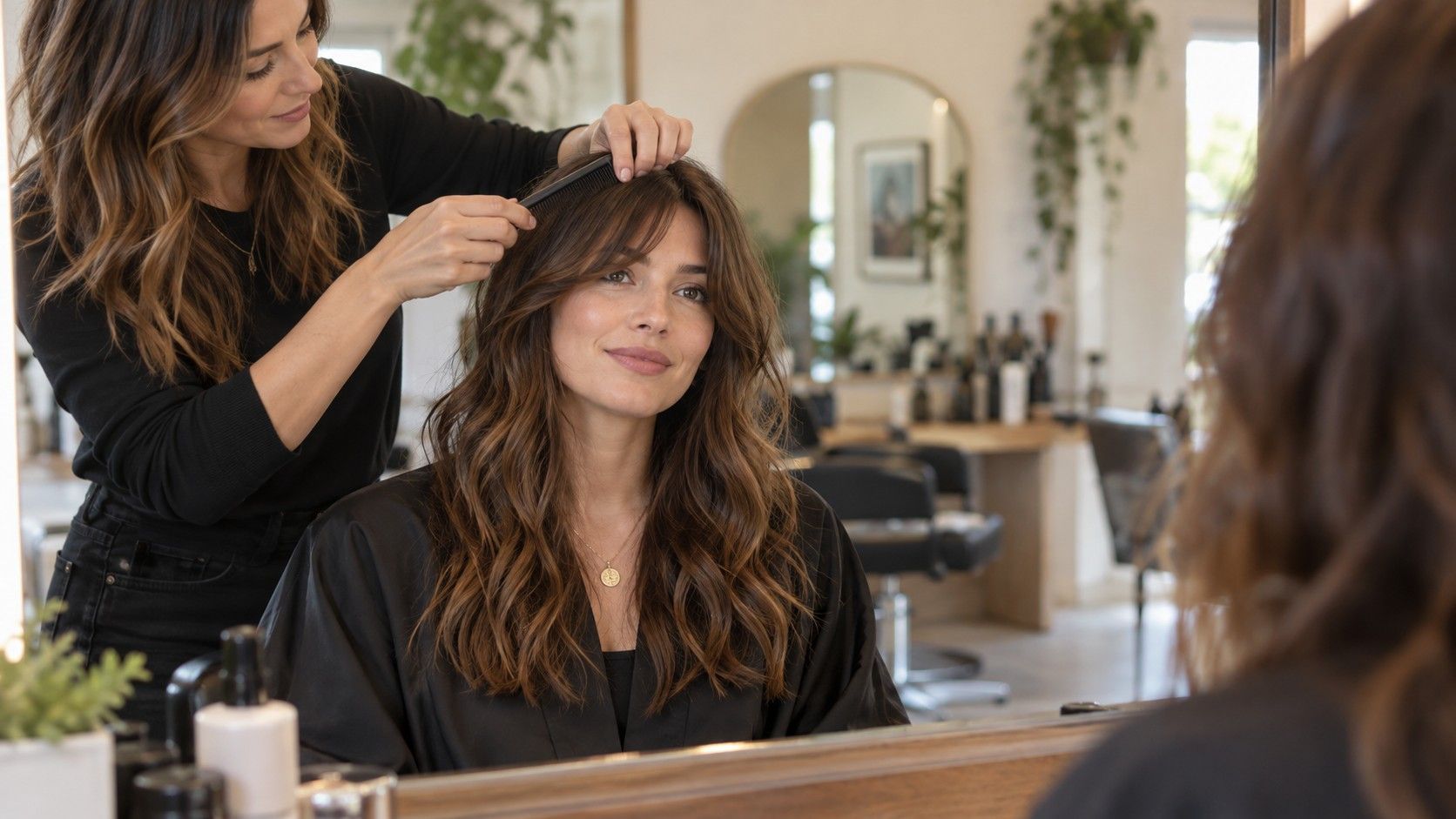
Look at the side pieces as carefully as the centre. Curtain bangs can be short enough to sit near the cheekbones or long enough to merge into the rest of the haircut. A fringe with a short centre and long edges behaves differently from an even line across the forehead. Ask where each part will land when dry, with your natural parting and your glasses on.
Glasses deserve a practical trial during the appointment. Hair may catch above a frame, push outward at the temples or fall behind a lens. Put the frames on before agreeing that the fringe length is finished. Moving the hair with your fingers for a moment does not show how it will settle through a normal day.
| Fringe idea | Effect to compare | Practical question |
|---|---|---|
| Full, fairly even fringe | A visible horizontal line and more forehead coverage | Will it lie forward without daily reshaping? |
| Curtain fringe | An opening at the centre with longer side pieces | Will the front part where you want it to? |
| Side-swept fringe | A diagonal line across the upper face | Does your growth direction support the sweep? |
| Light, separated fringe | Partial coverage with visible gaps | Will your density give the separation you like? |
| Short fringe | More visible forehead beneath a distinct edge | Are you happy with the exposed length and grow-out? |
Compare options around a rounded outline
If your face reads as round, decide first whether you want to repeat its curves or introduce another line. A softly curved fringe can echo the outline. A side sweep introduces a diagonal, while an open curtain shape creates a central gap. You may prefer any of those effects. “Round faces cannot wear full bangs” is too blunt to guide an actual haircut.
Compare the width of the fringe section and the side volume together. A broad horizontal fringe framed by dense side pieces creates a different silhouette from a lighter centre with hair tucked back. Look at the whole head in the mirror, then check the profile. Judging only a cropped front view misses the volume that makes the cut feel balanced to you.
For an oval outline with softer contours, the choice is still guided by the same practical details. A long fringe may feel heavy over the eyes even if a shape chart calls it suitable. An open forehead may be easier for your routine than constant trimming. If you want to emphasize your eyes, ask about the edge and separation around the brows rather than accepting a label as the plan.
Try different lines around square and tapered shapes
A square-like jaw and straighter facial sides can look striking beside a blunt fringe that repeats those lines. If you prefer contrast, a curved edge, broken texture or diagonal sweep may give the change you want. Avoid asking a stylist to “hide” your jaw unless coverage is specifically your goal. Say whether you want a graphic finish, visible movement or an open side instead.
For a heart-like outline, compare the amount of hair left at the temples and the way longer pieces fall towards the cheeks. A dense fringe creates substantial upper coverage; a centre opening reveals more forehead. Either can work with a tapered lower face. Check the ends of the curtain pieces, because a cut that looks airy when freshly styled may fall forward as a heavier panel.
With cheekbones broader than forehead and jaw, often described as diamond, side pieces can sit beside the widest point or pass below it. Compare both placements on reference photos with similar texture. If you enjoy the cheekbones being visible, keep the discussion focused on an open contour rather than following advice to cover the area automatically.
A triangle or pear-like outline may have a broader jaw than upper face. A fringe can add visual presence at the top, but that is optional. If your front hair is sparse or has a strong lift, forcing a dense full fringe to create that effect may be frustrating. A parting change or overall haircut shape could give a more manageable version of the idea.
Handle a longer face without treating length as a problem
For a longer outline, a full fringe can interrupt the visible vertical span of the forehead. If that is an effect you like, compare a clear horizontal line with a softer, more separated edge. The difference matters: a few thin pieces may feel much more open than a solid panel even when both end near the brows.
You can also choose to keep the sense of length. Long curtain pieces or a side sweep leave more of the central forehead visible and may fit the hairstyle you enjoy. There is no styling requirement to shorten the apparent face. Ask whether the chosen fringe supports your preferred silhouette from the front and side, especially if the rest of the hair is worn long and straight.
If your face shape feels intermediate, choose the line you like and test the practical limits. Growth direction may make a side sweep easy while a perfectly closed centre requires daily attention. Tell the stylist which compromise you would rather make: more forehead showing, a longer edge, a change of parting or a little extra styling time.
Plan maintenance and the grow-out before the cut
Ask how the fringe will be refreshed between full haircuts and what signs mean it is ready for a trim. A precise short edge can change noticeably as it grows; longer separated pieces may blend more gradually. Rather than accepting a fixed schedule, agree on the point at which hair touching your lashes, losing its opening or catching on frames becomes inconvenient.
Have the stylist demonstrate the simplest styling method on your hair. Watch the direction used at the roots and ask which steps are essential for the intended result. If the finished style uses tools or products you will not use at home, say so while the cut can still be adjusted. A realistic air-dried version is useful information, even if it looks different from the salon finish.
For growing out, discuss how the fringe can connect to the side layers and when it may tuck back. Clips, a changed parting or a side sweep can help through an awkward stage, but the best option depends on its length and your hairstyle. Avoid trimming a problem piece shorter repeatedly when your real goal is to let it join the rest.
Choose a fringe for face shape as one part of the decision, alongside its behaviour and your tolerance for upkeep. Leave the appointment knowing the dry endpoint, the root direction and a workable grow-out route. Those details make the choice easier to live with than a promise that one type of bangs is universally best for your category.