Choosing a beard for your face shape starts with the hair that actually grows, the length you enjoy wearing and the upkeep you can manage. Face proportions can help you compare silhouettes, but they cannot promise a particular beard or prescribe one correct style. Look at your growth first, then decide what you would like the outline to do.
Separate your growth pattern from your face shape
A reference picture shows a finished silhouette, often with growth density and hair direction different from your own. Before choosing a shape, inspect where your beard is fuller, where the boundary is less continuous and which sections point outward or lie close. Use an ordinary front view and a side view, with the beard dry and arranged as you normally wear it. These observations help explain which outlines you can maintain comfortably.
Keep facial proportions and beard volume as separate notes. A rounded jaw can wear an angular beard outline; a defined jaw can sit beneath a softly curved beard. The hair adds a visible layer around the lower face, so its shape may differ from the uncovered outline. You do not need to remove a beard just to obtain a face shape label. Describe the features you can see and leave the hidden jaw uncertain.
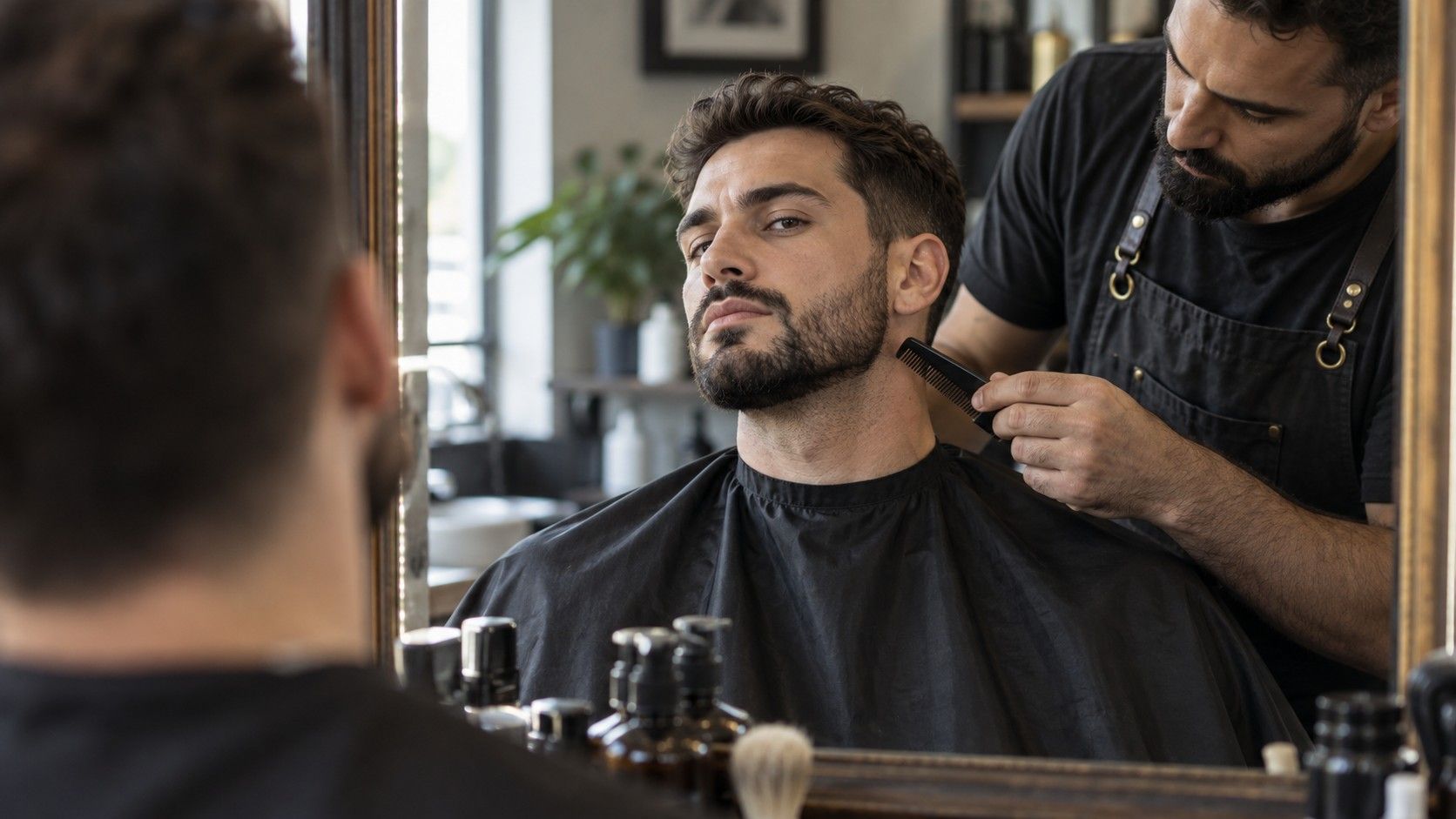
If you speak with a barber, bring a reference for the effect rather than expecting a copy of another person’s face. Point out the length at the chin, width at the sides and transition into the sideburns. Ask how those elements would work with your growth and which would require frequent trimming. A useful answer concerns your actual hair, not a rule that every face in one category needs the same beard.
Manage length on a rounded outline deliberately
For a rounded or compact outline, beard length at the chin can make the lower silhouette look more extended. Keeping the sides closer may make that difference easier to see. This is a styling effect you can test, not an obligation to make the face look longer. If you prefer a fuller, rounded beard, repeating the existing curves is equally intentional.
Compare front and side views before deciding where to remove volume. A beard may look broad from the front because of the side sections, while its chin length is much more visible in profile. Comb or arrange it consistently for each view. If you change the side length and the chin together, you may lose track of which adjustment created the result you liked.
Begin with the question you want the trim to answer. Do you want less bulk beside the jaw, a clearer chin edge or a compact outline that stays close to the face? Each calls for a different adjustment. Tell the barber the goal in those terms and identify any area you want to keep. “Round face” alone does not communicate whether you want to extend, repeat or simply tidy the silhouette.
A very pointed chin outline may look different once the hair is moved or washed. Check the shape in its ordinary arrangement before making the point the focus of the cut. Your willingness to arrange it each morning matters as much as the photograph of the finished style.
Work with an angular jaw without hiding it by default
An angular jaw can remain visible beneath a short beard, or a fuller beard can create a different outer boundary. Decide which effect interests you. A closer trim may let the existing corners show through; more volume can make the lower face read as a beard shape in its own right. There is no requirement to soften jaw corners because a diagram calls the face square.
Look at how the side sections meet the chin. A clearly defined change of direction can repeat an angular outline, while a gradual curve can create a softer transition. Ask a barber to show where that change would sit before substantial length is removed. Hair density and growth direction may make one edge easier to maintain than another.
Check the sideburn connection as well. An abrupt change in length near the ears can draw attention to the sides of the face, while a gradual transition creates another effect. Neither is universally better. Compare the proposed transition with your haircut and glasses, since all three occupy the same area around the temples and ears.
Do not judge the result from the front alone. Turn slightly and look at whether the beard boundary follows the intended line rather than a shadow. Ordinary lighting is more helpful than a strongly lit portrait for checking the outline you will actually wear.
Compare longer and tapered face outlines
If your overall face already reads as long, extra length only at the chin may extend that impression. You can test a more compact chin section or more side volume if you want a different silhouette. If you like the longer outline, keeping it is a valid choice. The useful question is whether the beard creates an effect you enjoy, not whether it makes the face resemble another category.
For an outline that narrows toward the chin, beard volume can introduce a wider lower boundary where your growth supports it. That may be an option for a heart-leaning or diamond-leaning face, but the label does not create hair where it is sparse. Ask what is realistic without relying on a sharp drawn edge that requires more coverage than you have.
| Effect you want to compare | Beard element to discuss | Check before trimming |
|---|---|---|
| A more extended lower outline | Relatively more chin length | How the length reads in profile |
| A more compact silhouette | Less projection at the chin | Whether the remaining shape suits your growth |
| More width near a tapered jaw | Side volume where coverage supports it | How the sides meet the chin |
| More visible natural jaw corners | A closer outline around the lower face | Which corners are visible beneath the hair |
Treat these as comparisons you can discuss, not a list of beard styles assigned to face shapes. The same adjustment can look different with curly hair, straighter hair or a different starting length. Keep the desired effect and the daily routine in the same conversation.
Check the neckline and cheek line in ordinary posture
The cheek line and neckline define where the beard ends, so small changes can alter the outline even without changing much length. Assess them with your head in a natural position. Lifting the chin high to inspect the neck shows a different view from the one others usually see. Use a mirror or photo that lets you return to ordinary posture before deciding on the boundary.
Along the cheeks, distinguish stray hairs outside your chosen edge from areas that form the main coverage. An artificially high or sharp reference line may not be reproducible with your growth. Ask the barber to show what can be retained and what would be removed. Leaving more hair initially gives you room to evaluate the line before taking it farther back.
At the neck, consider the beard’s front and side silhouette together. A boundary that appears neat in one view can look unexpectedly high in another. There is no single finger-width formula that accounts for every beard length, posture and preference. If you are uncertain, let a barber explain the proposed line while you can still see the existing coverage.
Keep the maintenance question concrete: how often would this edge need attention to retain the intended look, and can you see it clearly enough to repeat the trim? Choose a boundary you can manage rather than one that works only in the chair on the day of the cut.
Test a change gradually and keep a useful reference
Choose one main change for the next trim. You might reduce width at the sides while retaining the chin, or tidy the cheek line while keeping the overall length. Take clear before and after views under similar conditions if you find them useful. A dramatic change in lighting or head angle makes the comparison less informative.
Use a conservative starting length when trimming at home, following the instructions for your tool. Removing hair in small steps gives you time to inspect the outline before proceeding. If the intended edge is hard to see or reach, a barber may be the more practical option. A face shape guide cannot substitute for a clear view of the hair you are cutting.
After the trim, wear the beard in your ordinary routine before deciding what to change next. Notice how it sits with your haircut, glasses and collars, and how much arranging it takes. Record the useful specifics: side length you liked, chin outline to keep, or an edge you would prefer less sharply defined. Those notes will help at the next appointment more than a new face shape label.
The best working result is a beard you enjoy wearing and can maintain with the growth you have. Use proportions to describe options, then let comfort, routine and personal preference settle the choice.