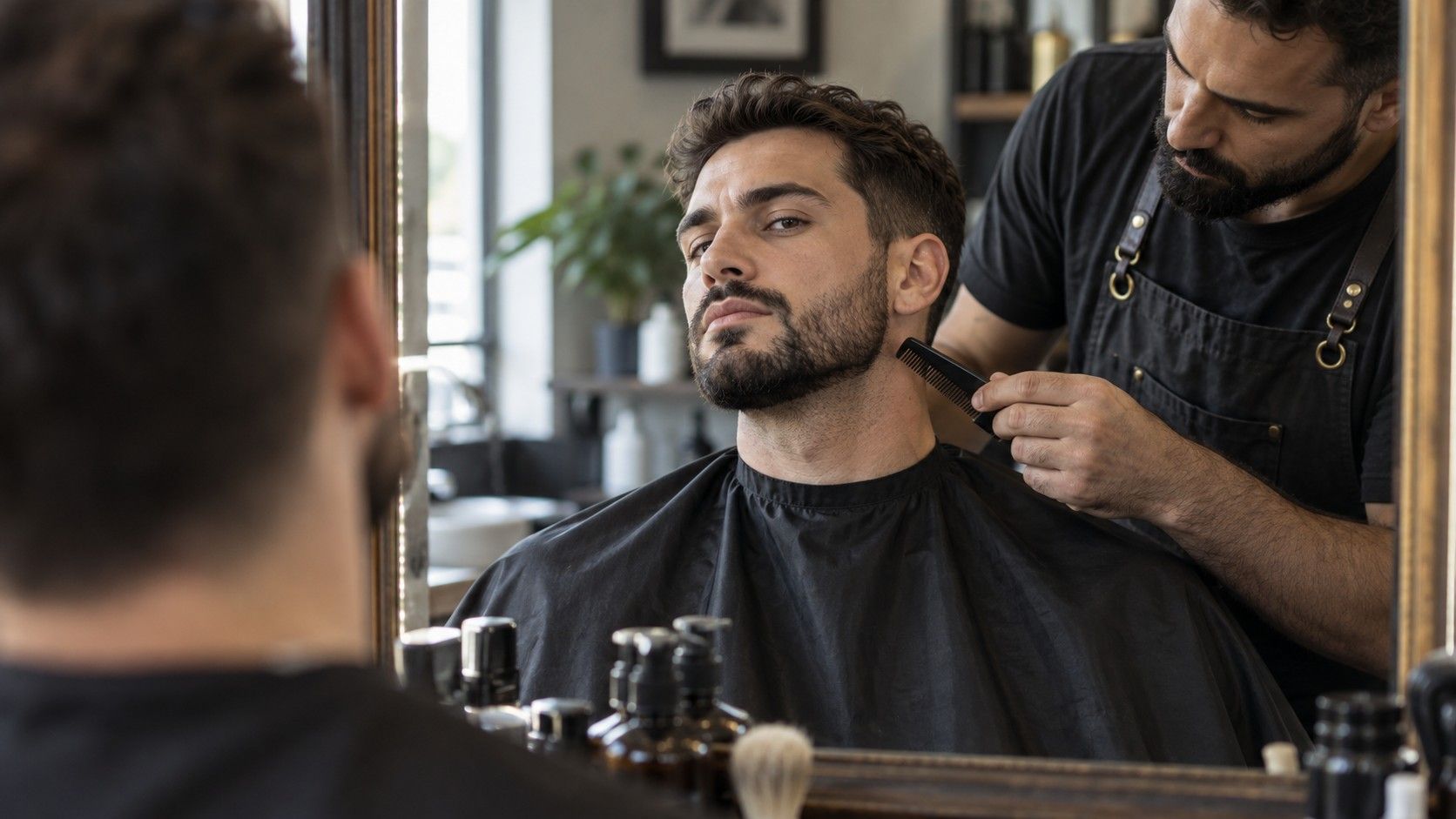
A face shape quiz works best when it gives you a way to look, rather than a verdict to accept. Hair, camera distance and a raised chin can change the outline you think you see. This written face shape test takes you through a neutral view, a few comparisons and a branching set of questions. Keep a mirror and a short note beside you. The aim is a description you can use when browsing haircuts or glasses, with room for features that belong to more than one category.
Start with a view you can compare
Pull your hair away from the sides of your face and reveal as much of the hairline as feels comfortable. Remove glasses for this first look because the frame can create an apparent width across the temples. Face a mirror with your head level, eyes forward and jaw relaxed. Avoid lifting your chin to see its edge: that changes the relationship between the lower face and cheeks.
Use soft light from the front. A bright lamp on one side can hide a jaw corner or make a cheek look more prominent than the other. If a fringe, head covering or facial hair obscures an area, write “uncertain” beside that feature. Guessing at a hidden hairline does not improve the result. You can still describe the visible outline and leave the forehead comparison open.
A photograph can help you trace the outline, but a close selfie is a poor tie-breaker. Keep the camera level with the middle of your face, avoid a wide-angle view and use some distance. Compare the image with your mirror view before trusting it. If the two seem dramatically different, reset the setup rather than choosing whichever result you prefer.
Compare length and width before naming a shape
Look from the centre of the visible hairline to the bottom of your chin. Then compare that vertical span with the broadest part of your face, usually somewhere around the cheekbones. You are deciding whether the face reads as clearly longer than wide or relatively similar in length and width. These are visual comparisons, not a requirement to meet a numerical ratio.
Record one of three notes: “clearly longer”, “similar”, or “hard to judge”. Do not include hair volume above the forehead, ears or a beard extending below the chin. Those details can affect styling, but they are separate from the outline being classified here. A long hairstyle can make the whole silhouette look elongated even when the visible face is fairly compact.
Find where the outline is widest
Compare three bands: the forehead above the brows, the outer cheekbone area, and the jaw near its corners. Keep your eyes on the face itself rather than the ears. Ask which band projects furthest to the sides. If two seem alike, record both. “Cheeks and jaw similar” is a better observation than forcing a winner because a quiz expects one answer.
A forehead that looks broad above a narrower lower face can support a heart-shaped description. A cheekbone area that projects beyond both a narrower forehead and a narrower jaw can suggest diamond. A lower face that is clearly broadest may fit a triangle or pear description. None of these clues settles the result alone: a soft taper and a sharp corner can give similar widths quite different outlines.
Watch what happens at the temples. A broad central forehead can taper at its sides, and the hairline may create a point or a rounded curve. A widow’s peak does not by itself make a heart-shaped face. For this check, compare the overall upper width with the jaw, then use the chin and cheeks to see whether the rest of the pattern agrees.
Read the jaw and chin as separate clues
Follow the line from below each ear towards the chin. Does it change direction at an obvious corner, or follow a softer curve? Next look at the chin on its own: broad, rounded, narrow or pointed are useful words. A narrow chin can appear with several face shapes. It becomes more informative when you know whether the forehead or cheekbones are widest.
Keep your mouth relaxed while you compare. Clenching can make the lower face look more angular; smiling changes the cheek contour. Facial hair can also supply a corner that the underlying outline does not have. If you cannot see the jaw clearly, keep that answer uncertain and use a provisional description based on the visible proportions.
Round and square labels often diverge here. When length and width appear similar, soft sides and a rounded jaw favour round, whereas a broad, more angular jaw and straighter sides favour square. Neither requires a perfectly circular or box-like outline. Faces have curves, small asymmetries and transitions that a simple drawing cannot capture.
Work through these face shape quiz questions in order
Question 1: Is your face clearly longer than its broadest width? If yes, write “longer” and continue to Question 2. If no, write “similar proportions” and continue to Question 2. If you cannot tell, write “length uncertain” and continue as well. Carry this first answer with you; later branches use it.
Question 2: Is your jaw clearly wider than both the forehead and cheekbones? If yes, your provisional result is triangle or pear. Go to Question 6 to check for conflicting clues. If no, if the widths are close, or if any area is hidden, go to Question 3. For a hidden area, note “width uncertain” rather than guessing. A jaw that simply feels prominent is not enough: compare its side-to-side span with the other two bands.
Question 3: Are the cheekbones clearly wider than both the forehead and jaw? If yes, ask whether the outline narrows above and below them. If it does, record diamond and go to Question 6. If the forehead is nearly as broad or the lower taper is unclear, record “cheekbone-led, uncertain” and go to Question 4. If no, go straight to Question 4. If the forehead or jaw is hidden, note “cheekbone comparison uncertain” and continue to Question 4 without assigning diamond.
Question 4: Is the forehead broader than the jaw, with the lower face tapering towards a narrow chin? If yes, record heart and go to Question 6. If only part of that description fits, note the feature that does fit and continue to Question 5. If no, continue to Question 5. If the forehead or lower outline is hidden, note “upper taper uncertain” and continue to Question 5 without assigning heart. Do not treat a pointed chin without an upper-to-lower taper as a complete heart result.
Question 5: Are the sides relatively straight and the jaw broad or angular, or are the contours mostly soft? Combine this with Question 1. Longer plus straighter sides and a broad angular jaw suggests rectangular; similar proportions plus those features suggests square. Longer plus soft contours and a gentle taper suggests oval; if length strongly dominates the outline, long or oblong may be a more useful description even with a rounded jaw. Similar proportions plus soft contours suggests round. If your answers fall between these pairs, keep both adjacent labels. With uncertain length, record the contour first and return to the mirror before choosing between the longer and compact options. If the contour is hidden too, keep the result descriptive and uncertain, then go to Question 6.
Question 6: Does your provisional result explain all your notes? Compare it against the widest band, length and jaw observations. If it explains the overall pattern, keep it as a working label. If hidden features left you without a label, keep only the observations you could make; no category is required. If a major feature disagrees, write a mixed result such as “oval with a broad square-like jaw” or “heart with prominent cheekbones”. If two earlier branches seemed equally convincing, retain both and use the table below to see which observation separates them.
| Close result | Clue to revisit | Useful note if it stays unclear |
|---|---|---|
| Round or oval | Whether the face is clearly longer than wide in a level view | Soft contours with intermediate length |
| Square or rectangular | Length compared with width, keeping the same broad jaw | Angular jaw with intermediate length |
| Heart or diamond | Whether forehead or cheekbones create the upper width | Tapered lower face with broad upper features |
| Oval or diamond | Whether the cheekbones stand distinctly beyond both ends | Longer face with cheekbone emphasis |
Use a mixed result when it describes you better
If you arrived asking “what is my face shape?” and left with two labels, the exercise can still be useful. Turn the result into one plain sentence: “My face is longer than wide, my cheekbones are broadest, and my jaw is softly rounded.” That description is more specific than an isolated label and gives a stylist concrete features to discuss.
When browsing glasses, compare actual frame width, bridge comfort and where the frame sits as well as shape suggestions. For a haircut, consider texture, density, styling time and whether you like hair around your cheeks. A category can narrow a search, but it cannot predict how a fringe behaves or whether a pair of glasses slides down your nose.
Keep the notes and stop retesting unless your setup was unclear or you have a practical reason to revisit it. You do not need to resolve every small asymmetry. Try an option because you like its effect, assess it in ordinary light and decide whether it suits your routine. The result belongs in your styling notes, alongside your preferences, rather than above them.