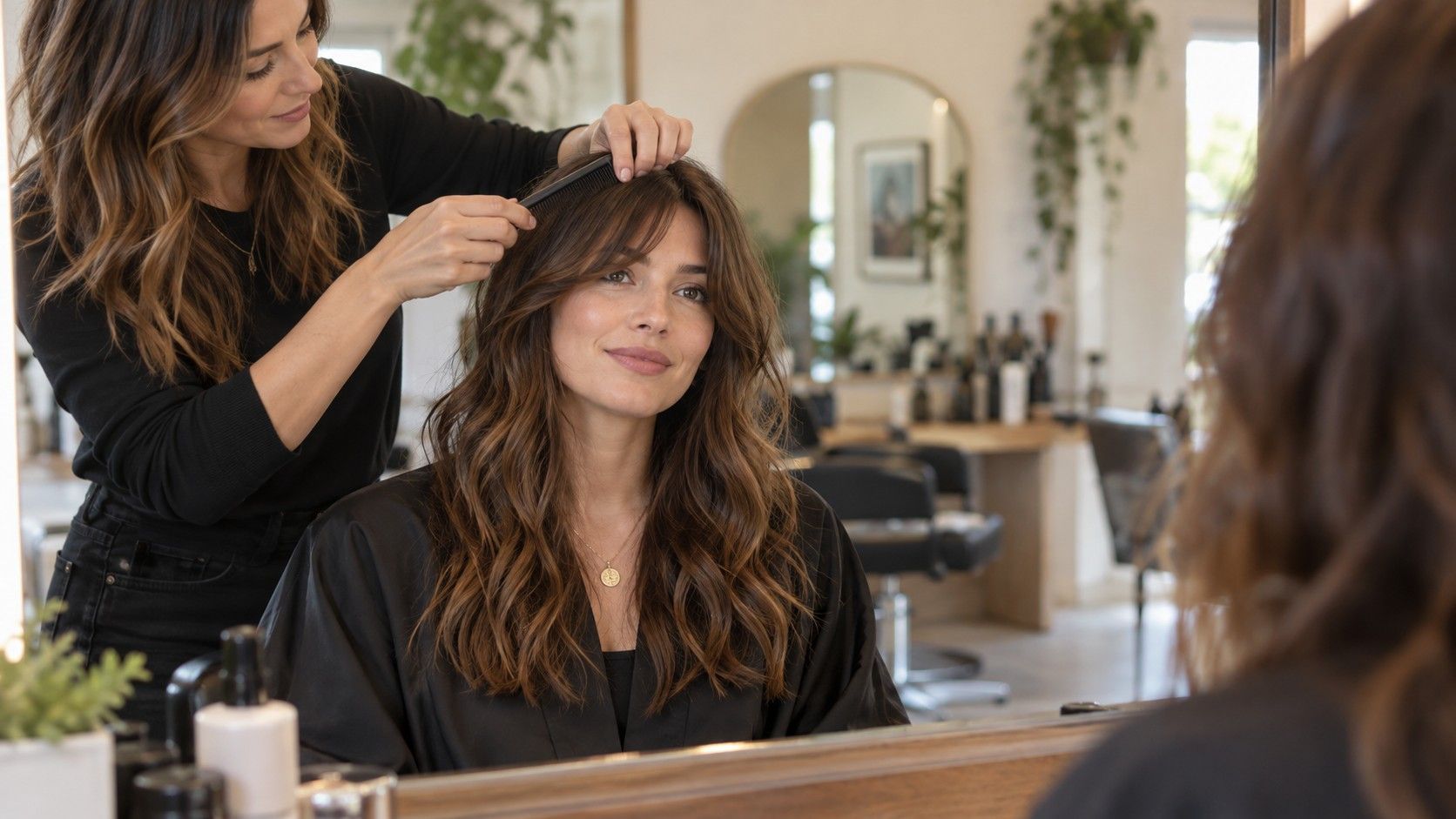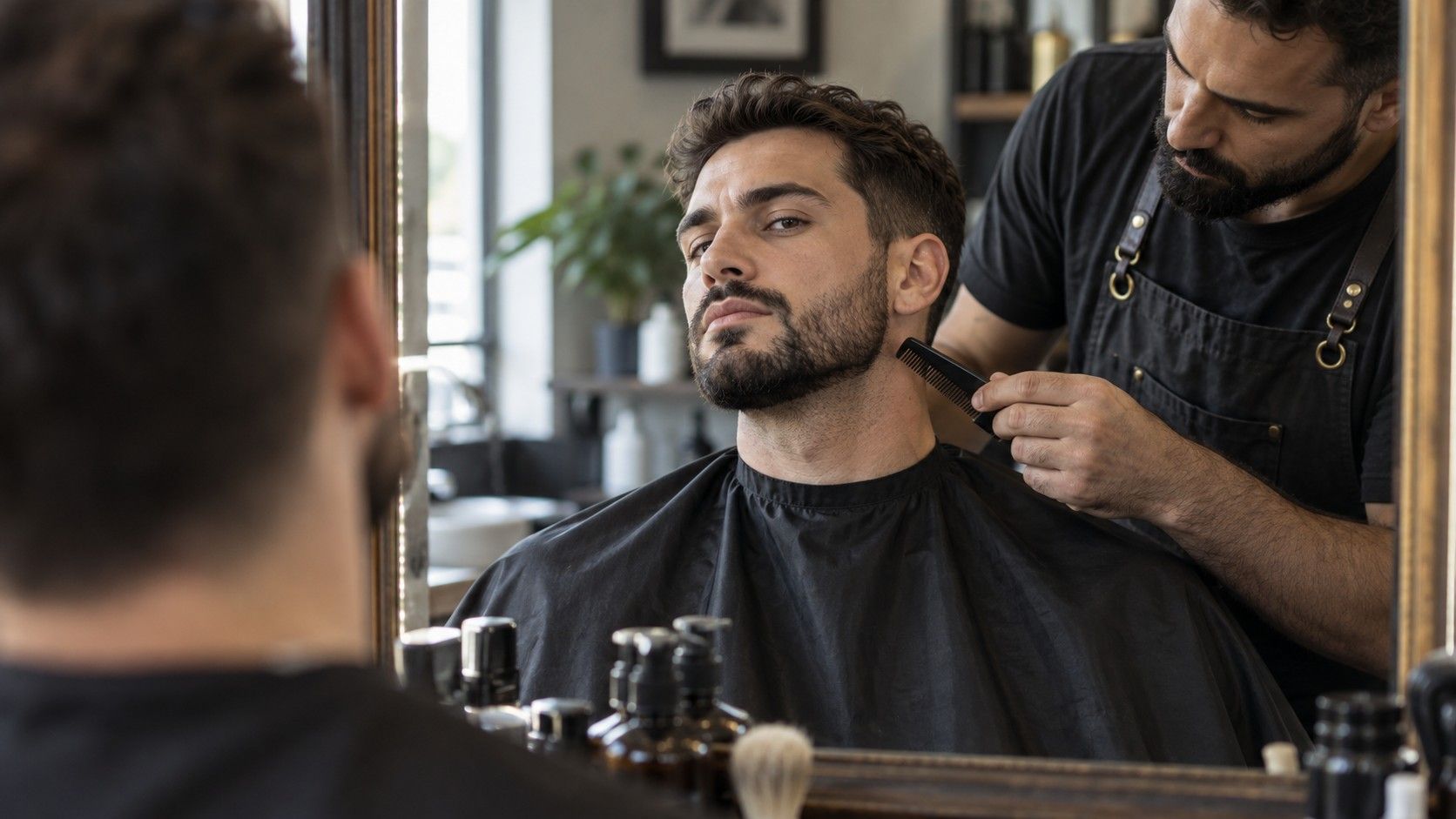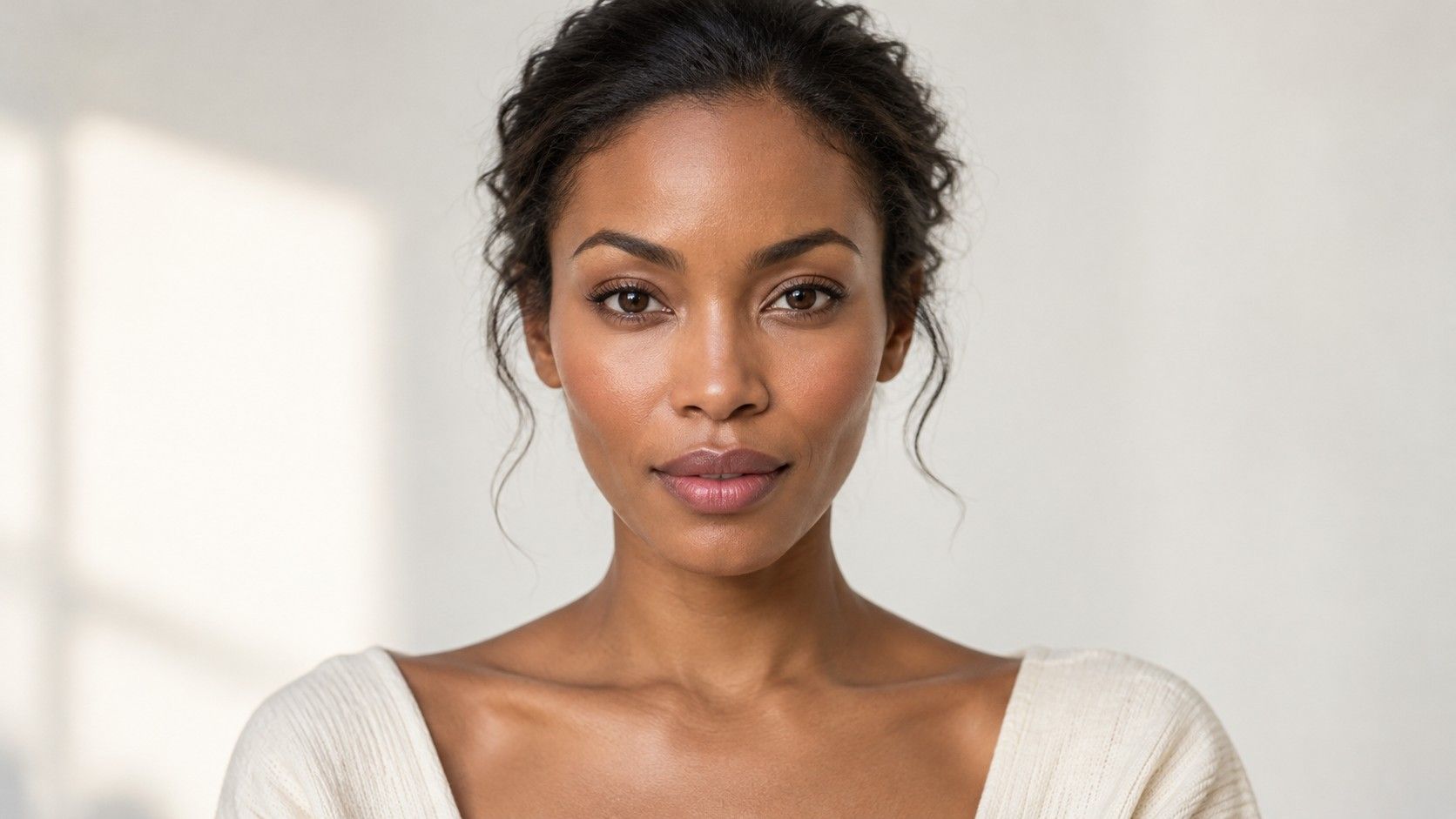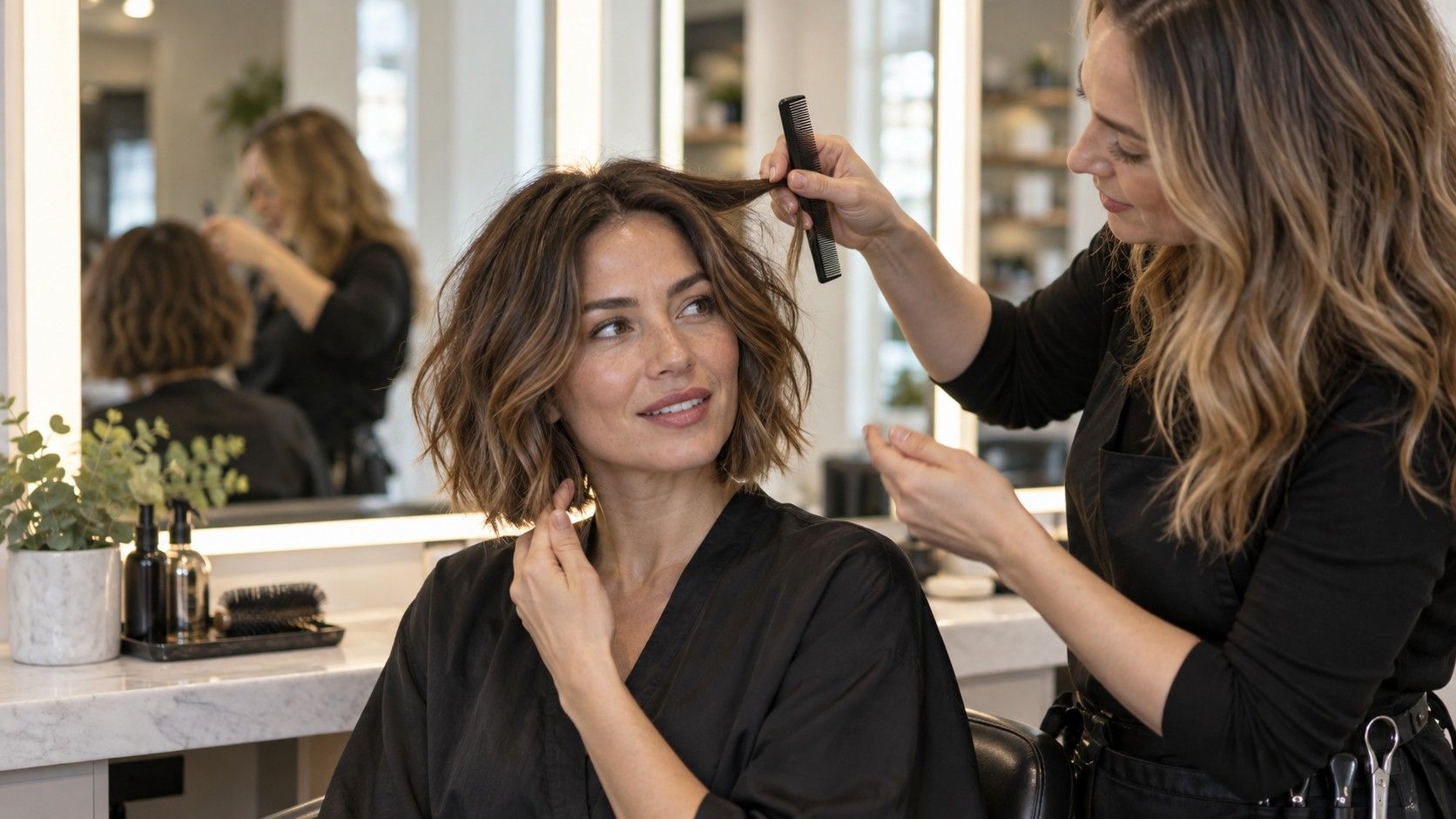
A list of haircuts for face shape can start a search, but it cannot tell a stylist how your curls dry, how often you tie your hair up or which parts of your current cut bother you. Use proportions to describe a visual effect you want, then build a plan around the hair and routine you have. A useful consultation ends with decisions about length, volume, movement and maintenance. It does not require you to find a single haircut assigned to your face category.
Choose what you want the haircut to emphasize
Look at your face with the hair pulled back, then let it fall as you normally wear it. Notice what changes. A fringe covers part of the forehead; side volume changes the overall width; tucked hair reveals the cheeks and jaw. Before naming a style, decide which of those effects you enjoy. You might want your jaw visible, more movement beside your cheeks or less hair falling into your eyes.
Describe the preference in ordinary language. “I like a strong line at my jaw” gives a clearer direction than “make my face look right”. If you have a round outline, you can choose curves that echo it or lines that contrast with it. A square-like jaw can be emphasized by a crisp edge or framed with soft movement. Neither approach needs to be a correction.
For tapered shapes, specify the feature instead of relying on a label. “My cheekbones look widest and my chin is narrow” is useful even if you are unsure whether the category is heart or diamond. Ask how a proposed layer would sit beside that widest area. You can prefer to show it, frame it or place movement somewhere else.
Map the length and volume together
Length is measured against your own landmarks: chin, shoulder and collarbone are useful reference points in a consultation. Ask where the hair will sit when dry and in its usual texture. A bob that reaches the jaw when straightened may sit elsewhere when wavy. The name of the cut is less specific than pointing to the intended endpoint on yourself.
Then decide where the haircut should have fullness. Volume at the crown, around the temples, beside the cheeks and near the ends creates different silhouettes. For a longer face, you may enjoy width at the sides, or you may prefer a narrow flowing outline. For a compact outline, you might like added height or an even, rounded shape. Choose the effect rather than assuming one is required.
A blunt perimeter and internal layers solve different questions. The perimeter sets the outer edge; layers can affect movement and where weight sits. Ask to see how the two work together in the proposed cut. “Lots of layers” is vague: short pieces around the face, a lighter interior and a strongly stepped outline can all look and behave differently.
| Your aim | Decision to discuss | Detail that may change the plan |
|---|---|---|
| Show the jawline | Where the perimeter ends and whether sides tuck back | Dry shrinkage and hair falling forward |
| Frame the cheek area | Where the shortest front pieces begin | Natural bend and ability to tie hair up |
| Keep a strong outline | Blunt edge versus visible layering | Density and how much styling supports the reference |
| Add movement | Placement of layers and removal of weight | Wave pattern and existing shorter sections |
| Leave the forehead open | Parting and front length | Cowlicks, growth direction and glasses |
Account for texture, density and the way hair grows
Show the stylist your hair in a state that represents ordinary life. If you normally wear your waves, explain that before discussing a sleek reference. If you alternate between natural curls and straight styling, decide which version the cut should prioritize. A shape can work in more than one state, but the endpoint and apparent volume may change.
Dense hair may need a different construction to create similar movement. Discuss where it tends to feel bulky and how the stylist would address that area. Avoid requesting a particular thinning technique solely because someone with the same face shape recommended it. Texture, previous cutting and the desired finish are more relevant to that technical choice.
Growth patterns at the front and crown can alter the shape even with a careful cut. Mention a parting that reappears, a cowlick that lifts or a section that always turns outward. Ask to see how the plan uses that behaviour. If achieving the reference requires fighting it every morning, decide whether the result is worth the extra work before hair is removed.
Compare fringe and parting as part of the whole cut
A fringe changes how much forehead is visible and introduces an edge near the eyes. A full horizontal fringe, a side sweep and an open curtain shape can give the same haircut quite different expressions. Compare them alongside the side length, rather than choosing bangs from a separate chart. Face-framing layers and a fringe also need to connect in a way you like.
For a rounded outline, an open centre or diagonal sweep may create a different line from a curved fringe; both remain options. With a square-like outline, you may prefer a strong geometric edge or softer separation. For a heart or diamond description, consider whether longer side pieces stop near the cheeks or pass below them. These are effects to try, not rules tied to the label.
A centre part often exposes different areas from a side part, but your growth direction affects how each sits. Move the parting during the consultation and watch what happens at the roots. A temporary change made with wet hair or firm styling may not hold without effort. Ask what the everyday version would require before treating a parting change as an effortless solution.
Put on your glasses and move your head normally. Hair can catch against the arms or fall into the lenses, and short front pieces may escape when you lean forward. If you need to keep hair off your face for work, ask which pieces will reach a clip or tuck behind the ears. Function is part of the haircut, even when reference photos show only a still pose.
Bring reference photos that explain the decision
Choose a small selection in which you can point to a specific feature: the perimeter, movement at the cheeks, fringe opening or crown shape. Explain what you like in each. One image for the overall length and another for the front can work better than asking the stylist to combine several complete haircuts that have conflicting structures.
Look for some similarity in texture and density, then ask what would change on your hair. Matching face shape alone does not make a photograph a reliable prediction. The reference may have been straightened, curled, pinned or arranged for the camera. A stylist can use it as a direction while explaining the finish your own texture is more likely to give.
Confirm the plan back in plain language before cutting starts. State the shortest intended area, dry overall length, amount of forehead coverage and whether a ponytail must remain possible. Ask the stylist to clarify any term you understand differently. A shared definition of “chin length” or “soft layers” is more valuable than confidently agreeing to a name.
Agree on the maintenance you will actually do
Describe a normal morning, including whether you air-dry, use heat, wash daily or refresh selected sections. Give a realistic account of the time and tools you are willing to use. If a haircut only produces the reference silhouette after a salon blow-dry, you should know what it looks like without that finish before choosing it.
Ask which maintenance task keeps the shape recognizable. A precise fringe may become inconvenient near the eyes before the rest needs attention; a short perimeter may lose its defined line as it grows. Agree on visible signs for a refresh rather than treating a calendar interval as universal. Your growth, preferred length and tolerance for change all affect that decision.
Have the stylist demonstrate the essential home steps and let you describe them back. Ask what can be skipped on a busy day and how the cut can be worn up or partly clipped. If the routine depends on a product or tool you do not own, discuss an alternative while the plan can still be adjusted.
When considering hairstyles for face shape, judge the result against your original aim: the feature you wanted visible, the movement you liked and the routine you agreed to. Keep a note of what worked as the cut grows. The next appointment can then refine a real experience with your hair, instead of restarting with another broad list of supposedly suitable shapes.