Square and round face labels can share a broad, compact outline. To tell them apart, look at how the jaw turns and how it joins the chin, then check that the photograph is showing those features clearly. A mixed description is useful when one tidy label leaves out what you can see.
Begin with the proportions the labels share
A square vs round face comparison often starts with the wrong shortcut: a broad face must be square, or full cheeks must mean round. Both categories can look relatively compact, and either can have prominent width. Start by comparing the visible length from hairline to chin with the width across the cheekbones. Then set that broad impression aside long enough to examine the lower outline. Width gives context; the way the outline turns is usually the more useful distinction.
Choose a front-facing view with your head upright and your expression relaxed. Keep the hairline and both sides of the lower face visible where possible. If you use measurements, repeat the same landmarks rather than switching between forehead width and cheek width. There is no universal cutoff that turns a face from round to square. Small differences in a home measurement do not deserve more weight than the outline you can consistently see.
Look for a pattern across the forehead, cheeks and jaw. A square description commonly refers to a fairly broad lower face with visible changes of direction near the jaw corners. A round description commonly refers to a more continuous curve around the cheeks and jaw. Both are simplified descriptions. A face can have rounded cheeks and noticeable jaw corners at the same time, so keep those observations separate.
Look at the jaw corners without chasing shadows
Follow the side of the face downward from the cheekbone toward the lower jaw. Near the back of the lower face, does the outline make a clear turn toward the chin, or does it curve through that area more gradually? A visible turn supports a square-leaning description. A smooth, fuller arc supports a round-leaning description. This is a comparison of the boundary, not of the darkness beneath it.
Side lighting can draw a sharp line on a curved face, while flat lighting can make a defined corner harder to see. Compare a straightforward, evenly lit view before relying on a dramatic portrait. Avoid clenching your teeth for the inspection; use a relaxed expression for both pictures. If the corners are hidden by hair, a beard or the angle of the photograph, mark them as unclear rather than assuming their shape.
A slight turn of the head may help you understand where the jaw sits, but do not compare one turned image with another person’s straight-on diagram. Perspective changes how much of each side you see. Return to the front view for the overall comparison. The aim is to recognize a feature that remains visible under ordinary conditions, not to find the one angle that creates a sharp edge.
Trace the transition from jaw to chin
The chin is the next checkpoint, although it cannot decide the category on its own. A square-leaning outline may keep more width through the jaw before reaching the chin. A round-leaning outline may flow into the chin along a softer continuous curve. A rounded chin does not cancel visible jaw corners, and a small flat area beneath the chin does not make the entire face square.
Trace the skin boundary on a copy of a photo if the details are distracting. Begin at one cheek, continue along the jaw and pass beneath the chin to the other side. Ignore lip shape, contour makeup and the shadow cast onto the neck. Look at where the line changes direction and where it narrows. The full lower outline is more informative than a close crop of the chin.
This table keeps the observations distinct. Treat the entries as descriptive clues, not a checklist with a required majority.
| Feature to compare | Square-leaning outline | Round-leaning outline |
|---|---|---|
| Jaw corners | More visible changes of direction | A more continuous curved transition |
| Lower-face width | Width stays apparent along the jaw | Width often reads through the cheeks and curved outline |
| Chin | May be broad, flat or rounded | May be rounded or softly tapered |
| Overall impression | Compact outline with clearer corners | Compact outline with smoother curves |
Avoid portraits that change the comparison
Before deciding whether you have a round or square face, check the picture itself. A close selfie, a tilted head and hair across one side can change the apparent proportions. Use a camera around face level with some distance between the lens and your face, and keep both sides visible. A second consistent view is useful; a folder of unrelated photographs can make the question harder.
Smiling changes the cheek area and may draw attention away from the jaw. Compare relaxed expressions first, then consider how you look in the expressions you use most often. A face shape label is usually based on an overall outline, whereas glasses and hairstyles are worn while moving and smiling. Both views have a purpose, but they answer different questions.
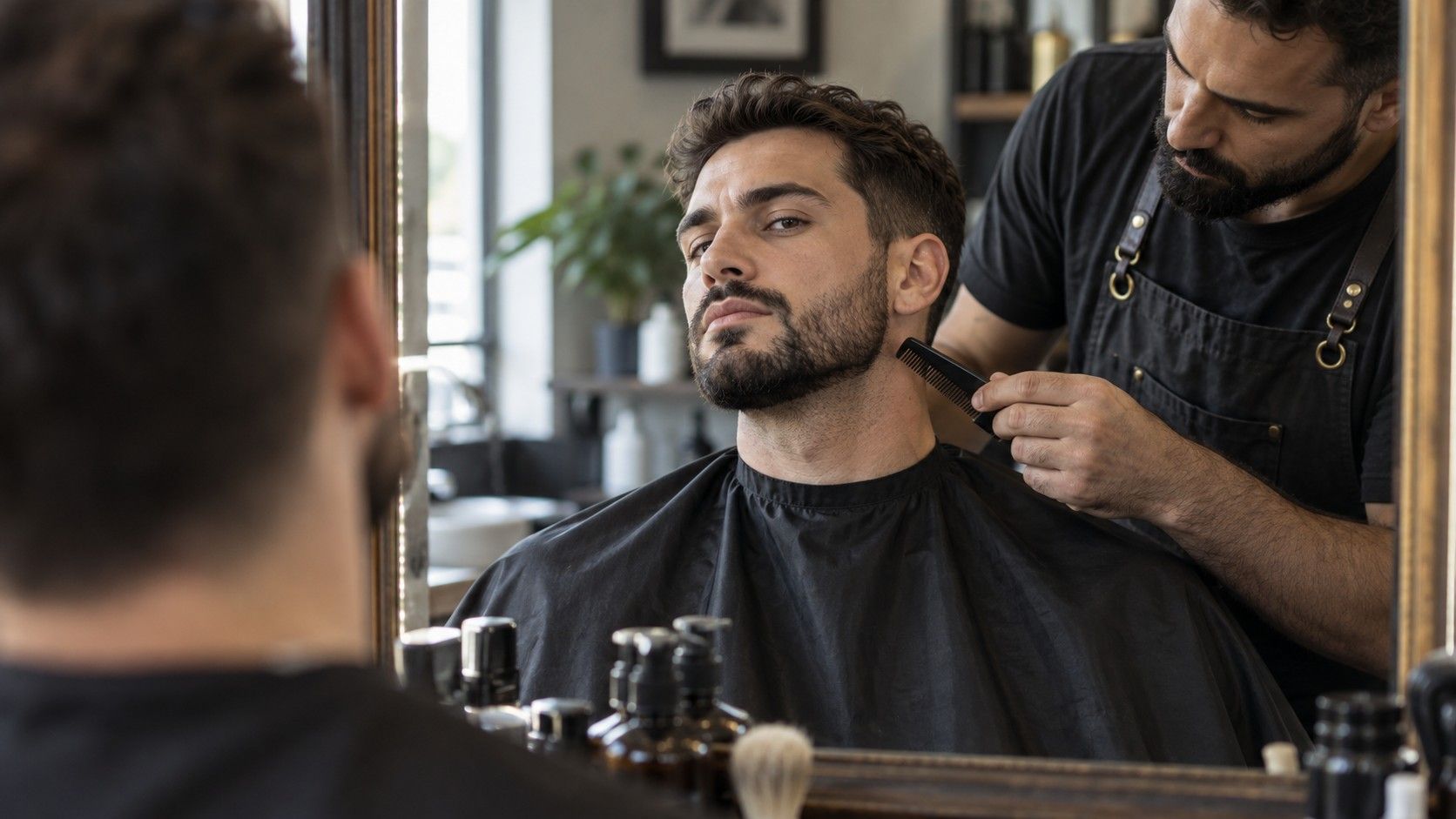
Beards and hairstyles create an additional silhouette. A squared beard can add visible corners around a curved jaw, while hair around the ears can soften a more angular boundary. Record the uncovered outline and the everyday silhouette separately if you can see both. When your goal is choosing glasses to wear with a beard, the everyday view may matter more to the decision.
Do not use beauty filters or an edited portrait as the reference for this exercise. If the original is unavailable, use a mirror or another ordinary photo. The clearest working result comes from a view in which you can identify the boundaries, not necessarily the picture you would choose to post.
Compare frames and hair around your preferences
Styling advice often says to pair square faces with curves and round faces with angles. That can be a starting experiment, but it is an aesthetic option rather than a rule. Curved frames may repeat rounded features or contrast with jaw corners. Angular frames may echo a defined jaw or introduce a different outline around soft cheeks. Decide whether you like repetition or contrast before treating either effect as desirable.
At a frame fitting, compare two clearly different shapes in similar sizes. Check the bridge, temple pressure and whether the lower rims touch your cheeks when smiling. Look at the full face as well as the frame close up. A shape that seems promising on a diagram can still be uncomfortable or poorly sized, and a comfortable frame outside the usual recommendation can be the one you prefer.
For hair, try changing where the volume sits. Tuck the sides back to reveal the jaw, then let them fall beside it; compare the effect without changing your camera position. If you are considering a fringe, discuss how it changes the visible forehead and how much daily styling it requires. Length, texture, upkeep and the way your hair naturally falls all affect the choice.
Keep your aim concrete. You might want the jaw corners more visible, a softer outline beside the cheeks, or less hair touching your glasses. These goals give a stylist something useful to work with. There is no obligation to soften a square outline or lengthen a round one.
Use a blended description when it fits better
If your cheeks curve smoothly but the jaw has visible corners, a blended description may be the most accurate result. “Rounded cheeks with a square-leaning jaw” says more than a forced answer. If the outline looks compact and curved while the lower jaw retains width, write that down too. The purpose of the label is to make a styling conversation clearer, not to settle a permanent identity.
Record the evidence clearly: overall length compared with width, whether the jaw corners are visible, and how the chin joins the lower outline. Add your current goal, such as finding lightweight glasses or choosing a lower-maintenance haircut. A quiz can provide a starting category, but your observations and preferences should remain available alongside its answer.
You can leave the result uncertain and still make a good choice. Try the frames, compare the hair arrangements and notice what feels comfortable in ordinary use. Square versus round is only one way to describe a face; it does not set a standard for attractiveness or prescribe how its owner should look.